


 EDA
EDA
 System
 IP
IP
 SolvNetPlus
 Training & Education
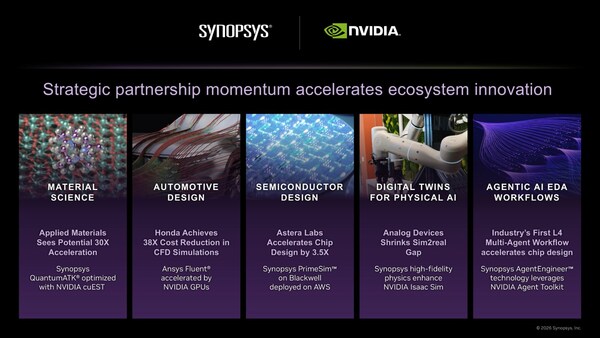
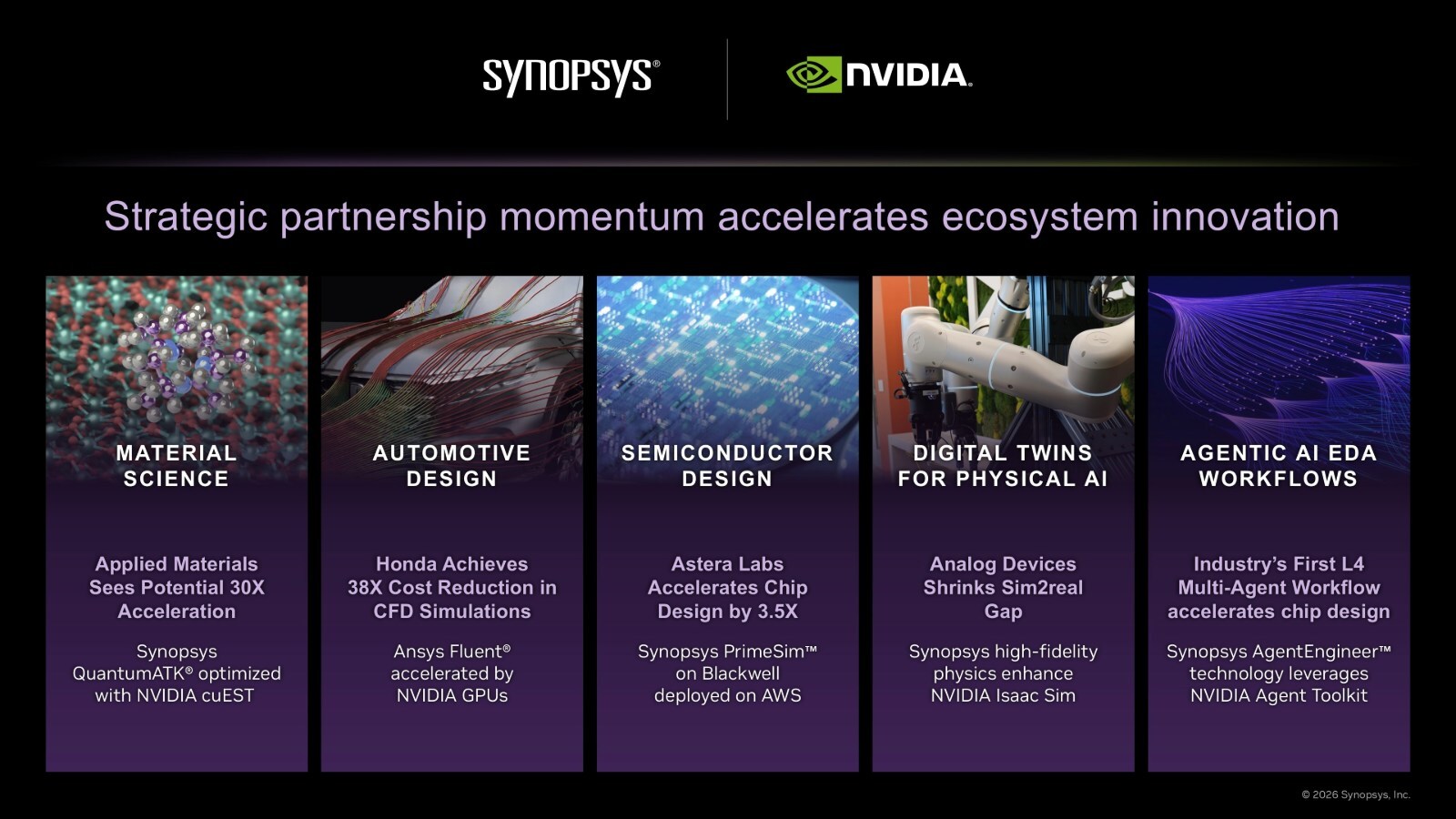
Customers across industries are revolutionizing product design and accelerating innovation with NVIDIA-accelerated engineering solutions from Synopsys
Key Highlights
- Synopsys is building an open, secure, hardware accelerated agentic AI stack in collaboration with NVIDIA to cater to use cases from silicon to systems
- Applied Materials collaborates with Synopsys to accelerate complex quantum chemistry simulations for large-scale dynamic materials modeling by up to 30X using Synopsys QuantumATK® optimized with NVIDIA cuEST
- Honda enabled practical, high-fidelity CFD using four GB200s, achieving 34X faster computation and 38X cost reduction compared to 1,920 cloud-based CPU cores
- Astera Labs accelerates advanced chip design for AI connectivity running Synopsys PrimeSim™ using B200 GPUs on AWS, achieving 3.5X speed up compared to multi-core CPU simulation
- Analog Devices, Inc. (ADI) is working with Synopsys and NVIDIA to advance real-world robotic manipulation by delivering industry-grounded robotic benchmarks and high-fidelity sensing simulations to close the sim-to-real gap
SUNNYVALE, Calif., March 16, 2026 /PRNewswire/ -- Synopsys, Inc. (NASDAQ: SNPS) at NVIDIA GTC 2026 is showcasing the progress and impact of its strategic partnership with NVIDIA to revolutionize design and engineering across industries. R&D teams, from the semiconductor industry to aerospace, automotive, industrial and beyond, face significant engineering challenges including increasing workflow complexity, escalating development costs, and time-to-market pressure. At GTC, Synopsys is demonstrating how integrating the strengths of NVIDIA's AI and accelerated computing with Synopsys' market-leading engineering solutions is enabling R&D teams to design, simulate, and verify intelligent products at lower cost with greater precision and speed.

"Traditional engineering methods can no longer keep pace with the complexity of today's software-defined, intelligent systems," said Sassine Ghazi, president and CEO of Synopsys. "Together with ecosystem partners, Synopsys and NVIDIA are re-engineering how products are designed and developed. By enabling the co-design of electronics and multiphysics, accelerating compute-intensive workloads and applying the power of digital twin for virtual prototyping, we are helping customers engineer the future."
"AI and accelerated computing are fundamentally reinventing engineering — from how products are designed to how they are built and operated," said Jensen Huang, founder and CEO of NVIDIA. "Modern engineering happens inside simulations and digital twins. Together with Synopsys, we are combining NVIDIA CUDA-X, Omniverse, and AI with Synopsys' silicon-to-systems platforms to reimagine engineering for the age of AI and turn growing complexity into a powerful advantage."
Shortening Compute-intensive Engineering Workloads with NVIDIA Accelerated Computing
Synopsys has the industry's broadest portfolio of engineering applications that enable AI and GPU-accelerated computing across engineering workloads — making engineering smarter, faster, and more intuitive. Customers are utilizing NVIDIA GPU-accelerated applications from Synopsys to speed up compute-intensive workloads. Today, Synopsys announced several examples:
- Applied Materials is collaborating with Synopsys and NVIDIA to advance AI and quantum chemistry R&D with accelerated materials modeling. Leveraging Synopsys QuantumATK®'s new integration with NVIDIA cuEST, early results from Applied Materials show a potential 30X speedup for complex quantum chemistry workloads compared to open-source models running on CPUs. Previously, Applied Materials achieved an 8X simulation speedup leveraging NVIDIA GPUs compared to multi-core CPUs for multi-nanometer amorphous systems featuring approximately 25,000 atoms.
"Applied Materials is working with Synopsys and NVIDIA to accelerate materials engineering innovations that can deliver tremendous improvements in energy-efficient performance of advanced semiconductor devices," said Gary Dickerson, President and CEO of Applied Materials. "This collaboration allows us to significantly reduce the time it takes to run simulations of material behavior at the atomic level, thereby enabling the industry to bring chip design breakthroughs to market faster."
- Honda has realized unsteady, large‑scale, high‑fidelity CFD that was previously impractical on CPUs through GPU acceleration on Ansys Fluent® fluid simulation software.
"We achieved 34x faster computation and 38x cost reduction using four GB200 GPUs compared to 1,920 cloud-based CPU cores," said Yusuke Uda, Assistant Chief Engineer at Honda. "Through close collaboration with Synopsys, Honda is accelerating the migration of its CFD simulations from CPUs to GPUs. This advancement enables us to continue delivering safer, higher‑quality products to our customers at appropriate cost, with consideration for the environment."
Astera Labs Accelerates Advanced Chip Design for AI Connectivity with Synopsys PrimeSim on AWS using NVIDIA Blackwell GPU
As AI scaling drives the need for high-speed connectivity to move massive datasets with near-zero latency, advanced chips with ultra-high-speed SerDes interfaces require extensive circuit-level simulations. Astera Labs achieved a 3.5X speedup running Synopsys PrimeSim™ using B200 GPU accelerated EC2 instances on AWS compared to CPU-only instances, dramatically shortening design validation cycles and enabling faster time-to-market for next-generation connectivity solutions.
The seamless access to GPU resources on AWS enables Astera Labs' design teams to focus on innovation rather than infrastructure setup, further accelerating time-to-market while supporting superior design accuracy.
"The collaboration between Astera Labs, Synopsys, NVIDIA, and AWS is transforming our ability to design advanced blocks for AI connectivity silicon," said Jitendra Mohan, Chief Executive Officer of Astera Labs. "By harnessing the power of NVIDIA B200 GPU-accelerated computing on AWS, we have significantly reduced simulation times and enhanced design accuracy, allowing us to deliver innovative connectivity solutions to the market faster than ever before."
"Astera Labs' work with AWS — achieving dramatically faster design cycles for the connectivity solutions that power AI — demonstrates how cloud technology is transforming innovation across entire industries," said Ozgur Tohumcu, General Manager of Automotive and Manufacturing at AWS. "We're enabling companies to access the most advanced computing tools instantly, changing how breakthrough technologies get built without the burden of managing complex infrastructure."
Digital Twins Augmented with Precision Physics Advancing Physical AI
Synopsys is an increasingly important component of physical AI development, reducing the gap between simulation and reality by grounding virtual development processes with real-world physics. From autonomous vehicles to humanoid robotics, precise simulation reduces iterations and improves synthetic data purity.
- ADI's Isaac Sim™ environment, built on NVIDIA Omniverse libraries, is now augmented with Synopsys physics. ADI is leveraging Isaac Sim to produce high-fidelity simulation assets for its tactile sensing prototype and time-of-flight vision systems, along with digital twins of next-generation robotic dexterity benchmarks. The benchmarks evaluate robotic policies for real applications, such as datacenters and automotive manufacturing. Ansys Mechanical™ software and AVxcelerate Sensors™ software bring simulation and reality closer with high-fidelity physics for simulating critical aspects of the test bench, including fiber optic cables and plugs, and sensor depth perception.
ADI's platform will support early adopters, including Kawasaki Heavy Industries, by enabling them to simulate robotic performance and generate synthetic data with greater predictive accuracy. This reduces the need for iterative physical testing and accelerates development. Synopsys' booth at GTC will feature a demonstration, including a bi-manual robotic arm setup with force, vision, and contact sensing, and a corresponding Isaac Sim visualization.
"Synopsys' multiphysics simulation is a critical enabler of realistic robotic test benches," said Paul Golding, Vice President of Edge AI at ADI. "Together with NVIDIA, we're using that fidelity to create benchmarks and digital twins that make sim‑to‑real transfer practical for real industrial dexterity."
Advancing Agentic AI for Engineering
Synopsys is building an open, secure, hardware accelerated agentic AI stack in collaboration with NVIDIA to cater to use cases from silicon to systems.
Synopsys' AgentEngineer™ multi-agent workflows leverage NVIDIA Agent Toolkit and support NVIDIA NIM inference services and Nemotron models, providing performance and optionality to customers.
At GTC, Synopsys is demonstrating agentic electronic design automation (EDA) workflows, powered by AgentEngineer technology that can orchestrate complex chip design tasks, scale across high-performance environments, and keep engineers in control — accelerating productivity, managing growing design complexity, and redefining how silicon is built in the AI era. Demonstrations will include Synopsys' new industry-first L4 agentic workflow for design and verification.
Engage with Synopsys at NVIDIA GTC 2026
Visit Synopsys' booth #1135 for demonstrations of the latest AI-powered engineering solutions and engage with Synopsys experts as they discuss the future of AI-powered engineering. Synopsys sessions include:
- Reducing the Sim2Real Gap for Industrial Robotics: Srinivasa Mohan, Distinguished Engineer and Scientist at Synopsys, will discuss how Synopsys, ADI, and NVIDIA are accelerating physical AI development with digital twins.
- Monday, March 16 at 3:00 p.m., SJCC Grand Ballroom Theater (L2)
- Shaping the Future of Semiconductor Manufacturing With AI: Shankar Krishnamoorthy, Chief Product Development Officer at Synopsys, will discuss how AI and digital twins are reshaping semiconductor manufacturing — from EDA and computational lithography to the design and operation of advanced fabrication plants.
- Tuesday, March 17 at 10:00 a.m., SJCC 211AC (L2)
- Accelerating Quantum Chemistry on GPUs—Latest Advances: Anders Blom joins this talk to discuss how Gaussian-basis quantum chemistry on NVIDIA GPUs is primed to change the world. The session will overview new technologies and offerings from NVIDIA that help accelerate this paradigm shift.
- Tuesday, March 17 at 4:00 p.m., SJCC LL21E (LL)
- How Simulation and AI are Giving Life to Digital Twins for Patient Care: Dr. Mark Palmer, Field CTO and Lead Chief Technologist of Healthcare at Synopsys, will present on how the convergence of wearable devices, simulation, and AI will improve patient-specific care with digital twins.
- Wednesday, March 18 at 11:00 a.m., SJCC LL21AB (LL)
- Interactive CFD at the Cutting Edge: Experiencing Digital Twins and Urban Simulation with Omniverse: Akira Fujii, Principal Application Engineer at Synopsys, will present on how the integration of Ansys Fluent and NVIDIA Omniverse enables easier scenario verification for product development and urban planning.
- Wednesday, March 18 at 6:00 p.m., virtual
About Synopsys
Synopsys, Inc. (Nasdaq: SNPS) is the leader in engineering solutions from silicon to systems, enabling customers to rapidly innovate AI-powered products. We deliver industry-leading silicon design, IP, simulation and analysis solutions, and design services. We partner closely with our customers across a wide range of industries to maximize their R&D capability and productivity, powering innovation today that ignites the ingenuity of tomorrow. Learn more at www.synopsys.com.
© 2026 Synopsys, Inc. All rights reserved. Synopsys, Ansys, the Synopsys and Ansys logos, and other Synopsys trademarks are available at https://www.synopsys.com/company/legal/trademarks-brands.html. Other company or product names may be trademarks of their respective owners.
Contacts
Media
Pete Smith
pete.smith@synopsys.com
corp-pr@synopsys.com
Investors
Tushar Jain
synopsys-ir@synopsys.com
SOURCE Synopsys, Inc.